

AI has been in the enterprise playbook for years. Predictive models? Check. RPA bots? Deployed. Workflow automation? Already in place.
Agentic AI is the latest category on the table, and it is gaining momentum as a new way to get work done. Unlike traditional AI that predicts or analyzes, it acts. It coordinates workflows across multiple systems, making it far more powerful than anything most companies are running today.
But while the potential is real, so are the challenges.
According to SS&C Blue Prism’s 2025 survey, many leaders are seeing agentic AI as a way to boost efficiency and reduce human oversight. Yet 78% don’t fully trust these systems, and nearly 70% of AI projects never reach production.
That gap between potential and reality is where most executives get stuck. Where does it fit in our organization? How long will deployment really take? What will it cost? Will it integrate with ERP, CRM, and compliance systems we already have? Can it be secured? And perhaps the toughest one: do we even have the right data to make it work?
Based on conversations with AI experts, this article breaks down what agentic AI for enterprise really means in practice—and how to separate hype from value when making investment decisions.
Enterprises exploring these capabilities often rely on specialized Agentic AI development services to design, integrate, and deploy intelligent agents within existing enterprise systems.
Do we actually need Agentic AI?
Let’s start with the question most execs are secretly asking: Is this really necessary?
After all, every enterprise already has automation. Some use predictive AI models for forecasting and insights. Many rely on rules-based RPA bots to speed up processes. Workflow tools are already in place to connect systems.
So why add another layer?
The short answer: because automation handles tasks. Agentic AI handles orchestration.
If your workflows are simple, automation does the job. But if they:
- Span multiple systems,
- Involve layered decision-making, and
- Constantly change as business conditions evolve,
…then agentic AI for enterprises delivers where traditional automation falls short.
Consider three examples:
Insurance
Claims processing involves multiple approvals, compliance checks, and customer interactions. An agentic AI can coordinate these steps, reducing average settlement times without compromising oversight.
Financial services
Transaction reconciliations often span multiple systems and jurisdictions. Current automation tools handle standard cases well, but exceptions require human intervention. Agentic AI can process exceptions dynamically, escalating only where judgment is essential.
Supply chain
Global disruptions—such as port delays or supplier shortages—demand rapid, coordinated adjustments. Agentic AI can reroute orders, update logistics partners, and trigger customer notifications in near real time.
In each scenario, the value emerges not from better predictions, but from closing the loop between insight and action. Enterprises that focus on such systemic bottlenecks are positioned to extract real value.
Also Read: AI Agent Orchestration- Best Practices, Cost Pitfalls & How to Avoid Them
How long does agentic AI deployment really take?
You’ll hear “weeks” from vendors. That’s true—if what you want is a pilot. A small, sandboxed agent can be built quickly to demonstrate functionality.
But reality for enterprises is different. They run on production-grade systems that have to scale across departments, geographies and compliance requirements. That means:
- Integration with CRM, ERP and data systems
- Monitoring and audit trails to ensure accountability
- Governance frameworks for oversight
That’s where the timeline stretches. Hence it can take several months for full-scale, enterprise-ready implementations. Also, platform-based solutions with prebuilt connectors can speed things up, while custom-built systems, especially those handling complex tasks, naturally take longer.
What about costs? Aren’t APIs cheap?
This is where many leaders underestimate investment.
On paper, API costs look trivial. Fractions of a cent per thousand tokens. Almost too good to be true.
And it is—because agents don’t make just one API call. They:
Loop.
Retry.
Branch out.
Coordinate with other agents.
Multiply that across enterprise-scale workflows, and the bill grows quickly. But API calls are only one part of the picture. Enterprises must also account costs for:
- Infrastructure and hosting.
- Developer and integration effort.
- Ongoing monitoring and maintenance.
So, is agentic AI expensive? It can be—if applied in the wrong places.
The ROI isn’t in token pricing. It’s in whether orchestrated workflows deliver measurable speed-ups, cost savings, or risk reduction that outweigh the investment.
The enterprises that win with agentic AI don’t deploy it everywhere. They use it surgically—in high-value workflows where the gains are undeniable.
Can it easily integrate with our existing systems?
This is the make-or-break factor.
Yes, agentic AI can integrate with ERP, CRM, data warehouses, compliance tools, and more. The real question is: will you let it?
If you deploy it as a side project or a stand-alone app, it will stay stuck as a pilot. It won’t touch the core of your business. But if you design it as an overlay that connects the systems you already rely on, it becomes the connective tissue your stack has been missing.
That’s the key mindset shift: enterprises don’t want new silos. They want existing investments to perform better. Agentic AI isn’t “another tool.” Done right, it’s the layer that makes your existing stack work together seamlessly.
How secure is agentic AI?
Here’s where clarity matters. Agentic AI for enterprises isn’t insecure by design, but it isn’t automatically safe either.
Why? Because these systems don’t just analyze—they act. That means they can trigger workflows, move data, and execute tasks. That power, without controls, can become a liability.
To solve this you can:
- Add guardrails to define what an agent can and cannot do
- Restrict access to the minimum necessary systems
- Keep human oversight for high-stakes decisions
Think of agentic AI like a capable intern. Left unsupervised, it can cause problems. But with structure, oversight, and clear boundaries, it can dramatically accelerate your workflows.
Security isn’t a blocker. It’s a discipline.
Do we need massive datasets to build agentic AI for enterprise?
No. And this is one of the most persistent myths slowing down adoption.
Agentic AI for enterprise doesn’t require training new models on billions of records. Instead, it relies on workflow clarity.
Enterprises already have the data. The real challenge is mapping processes and giving clear examples so the system knows how to act.
In fact, the enterprises that succeed with agentic AI won’t be the ones with the biggest datasets. They’ll be the ones with the most well-defined processes + data that is agentic AI-ready.
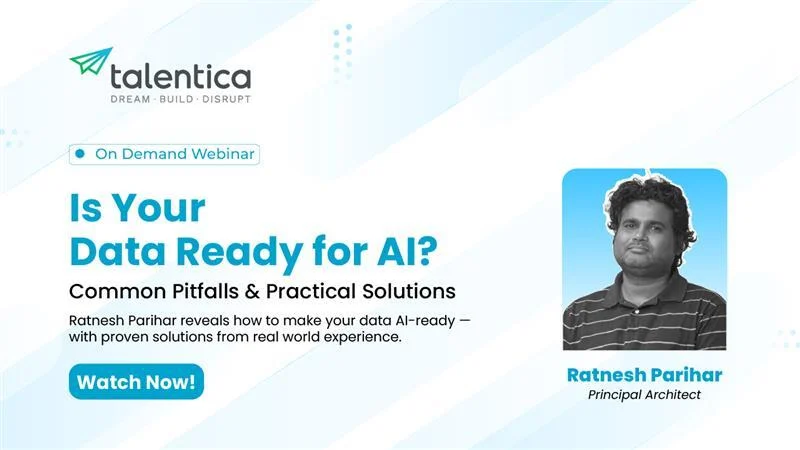
To make sure that your data is ready to support agentic AI at scale, you can even watch our recently hosted 30 min webinar, “Is your data ready for AI? Common pitfalls and practical solutions”. Here Ratnesh Parihar, our Principal Architect shares practical strategies to prepare your enterprises data for agentic ai and gen ai with real-world applications.
A framework for enterprise readiness
Executives evaluating agentic AI should assess readiness across four dimensions:
- Strategic relevance. Are your most critical bottlenecks workflow-driven rather than purely analytical?
- Integration maturity. Do your IT systems allow for seamless orchestration, or will legacy architecture pose barriers?
- Governance readiness. Are compliance and security frameworks mature enough to handle autonomous system actions?
- Value alignment. Are there workflows where the potential ROI clearly outweighs costs of development and deployment?
This framework helps boards and C-suites determine whether agentic AI represents a near-term opportunity or a longer-term aspiration.
Taking the next step with Agentic AI
Once you’ve assessed readiness across strategy, integration, governance, and value, the next question is: what do you actually do? The answer is deliberate, not indiscriminate.
Start by identifying high-value workflows—those that span multiple systems, require layered decisions, and change frequently with business conditions. These are where agentic AI delivers measurable impact. Next, run a focused pilot. Keep it small, but ensure it has clear success metrics: reduced cycle times, lower risk, or fewer human handoffs.
Integration matters. Agentic AI should not be another silo. Design it as an overlay connecting the systems your teams already rely on. Prebuilt connectors can accelerate deployment, but complex workflows may require tailored integration. And never skip governance and security protocols: define boundaries, maintain oversight, and limit system access to what’s necessary.
A real-world example:
Automated Marketing Campaigns with Agentic AI Systems
A marketing startup wanted to use agentic AI to automate end-to-end campaign management. By enabling multi-agent collaboration, we helped them automate campaigns with minimal human involvement, while still keeping human-in-the-loop for approvals and strategic oversight.
The agents planned, executed, analyzed, and optimized campaigns across industries—handling product launches, flash sales, and holiday promotions at scale. The result: higher ROI, faster campaign rollouts, and the ability to handle growing volumes without additional resources.
The takeaway is clear: agentic AI for enterprise isn’t about replacing human judgment, but about orchestrating workflows so that people focus on strategy while agents handle execution.
Conclusion
Agentic AI for enterprise marks a shift from task automation to intelligent orchestration. It doesn’t just analyze data or automate steps—it closes the loop between insight and action. Enterprises that adopt it wisely—focusing on high-value workflows, seamless integration, and disciplined governance—stand to gain agility, efficiency, and long-term advantage.
The real question is no longer whether agentic AI for enterprise is powerful. It is. The question is whether your organization is ready to harness that power where it matters most.
At Talentica, we’ve seen this first-hand. From building agent-driven marketing campaign systems that scale without additional resources to designing governance frameworks that keep human oversight at the center, we help enterprises move from pilots to production-ready agentic AI systems.
Our approach emphasizes seamless integration with your existing stack, AI-ready data preparation, and secure orchestration so you can extract measurable value where it matters most.
If you’re exploring agentic AI for enterprise, let’s talk. Our experts can help you identify high-value workflows, design secure orchestration frameworks, and accelerate adoption from idea to impact.