

Monolithic models are not good at managing complex, multi-step tasks and is the reason behind the shift towards Multi-Agent Systems (MAS). MAS reduces errors and hallucinations, allows parallel executions which support scaling, and is opaque in privacy matters. The global multi-agent systems market is expected to touch $375.4Bn by 2034.
In April 2025, Google launched A2A architecture “to automate complex enterprise workflows and drive unprecedented levels of efficiency and innovation.” This is an open protocol and complements Anthropic’s Model Context Protocol (MCP). Agents, regardless of their underlying technologies, can collaborate in this system.
Since it launched, I have had the chance to work on this Google agent-to-agent architecture in quite a few projects. Based on my insights, I have written this article to walk you through the fundamentals of A2A architecture, common misconceptions, when to adopt A2A and when not to, its architecture, core components, and its limitations.
What is agent to agent architecture (A2A):
Think of agent-to-agent (A2A) architecture as a communication pattern that enables independent AI agents (which can be built in any language; in Python, JavaScript, etc.) to talk with one another to achieve a goal.
In an Google A2A AI architecture, each agent has a clear role and responsibility. Agents exchange information such as requests and responses through standardized communication rules. Here coordination happens through collaborative interaction between agents.
Let me share an example to have this A2A architecture explained in a simple way. Case in point a system to book travel plans: one agent can focus on booking hotels, one can find the best restaurants, and there could be a third to handle the routes of popular locations. Without A2A architecture, each of these agents would communicate in its own custom way- one agent might send raw text, and another might require tightly coupled integrations. This can lead to a system that is hard to scale or modify as more agents are added. A2A architecture solves this by introducing a common A2A protocol for AI agents that standardizes how agents send requests, share context, and return results. Instead of building different integrations between agents, each agent simply follows the same communication rules.
This standardization improves interoperability, reduces complexity, and makes multi-agent systems far more flexible and scalable.
What agent to agent architecture is not (Common Misconceptions):
A2A AI architecture is often misunderstood. It is neither an agentic framework to build agents nor the same as simple API calls used to communicate between services. A2A architecture specifically focuses on standardizing the communication that happens between autonomous agents, so they can collaborate to achieve a goal or complete a task.
Another misconception is that A2A is plug and play library for agentic systems. No it is not something you just install and start using. It is a design pattern or protocol layer that you build into your system to enable intelligent and standardized communication between agents.
When to Adopt A2A AI architecture
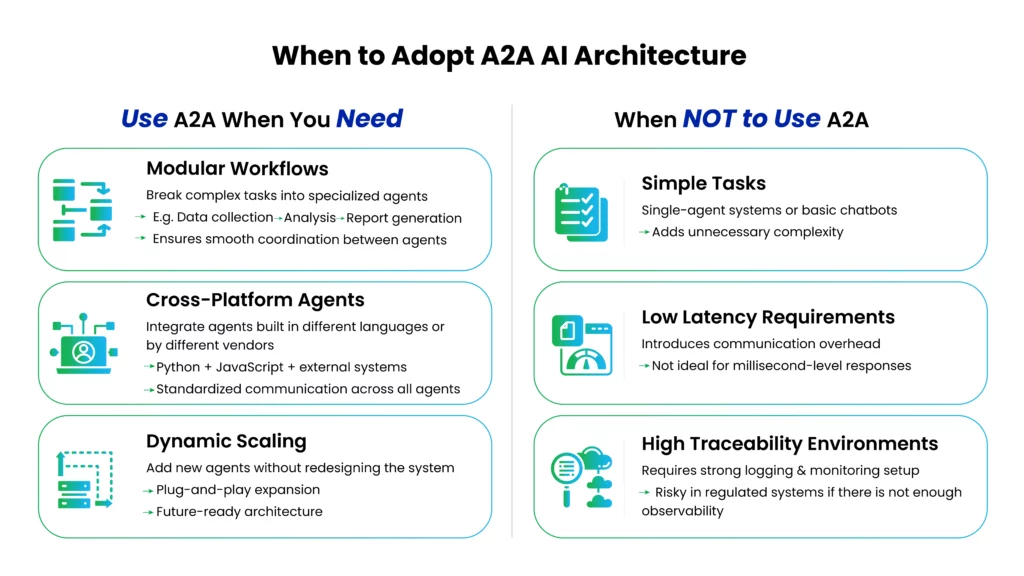
You should consider an A2A architecture when you want
- Modular workflows: You need A2A AI architecture to break down complex tasks into specialized agents. For example, in a complex workflow like automated research, one agent gathers data, another analyzes it, and a third generates a report. By using the A2A AI protocol here, you can ensure smooth handoffs and coordination between agents.
- Cross platform agents: Suppose you have one agent built in Python and another in JavaScript. Use A2A architecture to integrate these agents built by different vendors or in different programming languages into the same system. A2A protocol for AI agents standardizes their communication, enabling seamless integration.
- Dynamic Scaling: If you have a plan to add new agents or capabilities over time without redesigning the entire system, use A2A AI architecture. With A2A protocol for AI agents in place, you can plug new agents into the existing system and start collaborating immediately.
When you should not implement A2A
But not every project needs A2A. Skip it if:
- Simple task: If you are building a simple, single agent or a chatbot which answers simple FAQ’s or simple tasks, adding A2A AI architecture is unnecessary as it adds complexity without much benefit.
- Latency: A2A’s overhead from negotiations might slow things down. If you need a millisecond response, A2A will frustrate you.
- Tracing and logging are key: Avoid it in highly regulated environments where traceability is key. Go ahead only if you have built robust logging.
Agent to agent architecture brings scalability, standardization, but also complexity. If you don’t need it, it can slow you down.
Architectural overview of A2A systems
An agent-to-agent architecture system is not just a messaging system, but a distributed coordination layer built for autonomous AI agents that can reason and act independently and co-ordinate with each other. Think of it as a setup, every agent is a self-contained reasoning entity, not a dumb function.
Each agent typically contains –
- reasoning part (LLM-based)
- set of capabilities
- its own environment (language agnostic)
Most practical implementations follow a client-remote pattern at the agent-to-agent protocol level, like one agent proposes a task; another executes it and streams back or shares the results. Roles can flip mid conversation. This adds flexibility but also asks for clean lifecycle handling (cancellation timeouts, context propagation).
In short, a good A2A AI architecture creates clear, observable, and recoverable boundaries between autonomous agents so the system can function without being chaotic. Agent discovery by an orchestrator/controller or sometimes by a sub agent, typically, starts the implementation . Each agent can discover the capabilities of other agents using a well-known A2A agent path. Based on this discovery, the agents communicate with each other and execute tasks collaboratively.
Core Components of A2A Architecture
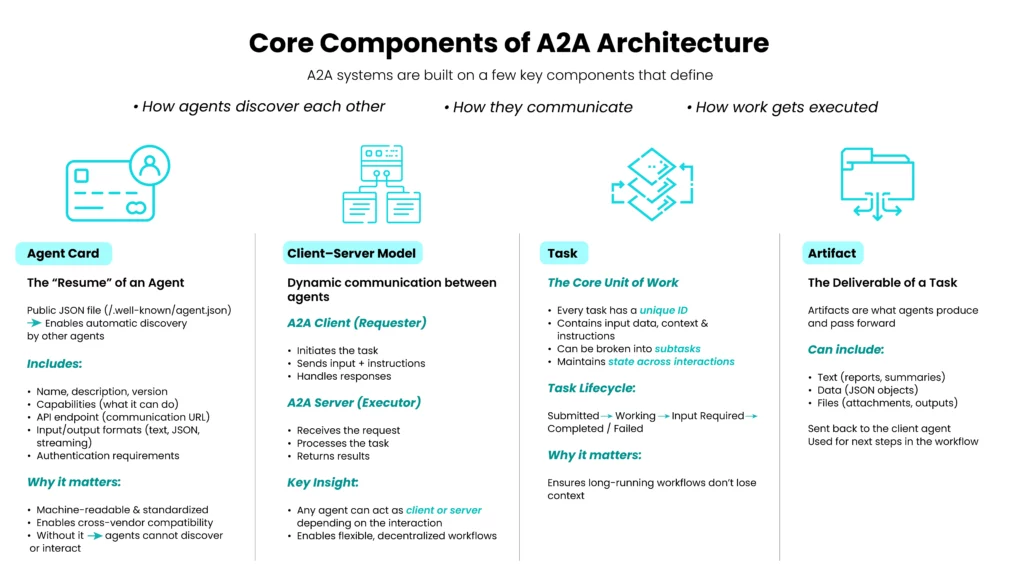
The A2A system is built around a small set of components. These components define how agents describe themselves and how they interact and how they work on the input they receive.
- Agent card:
This is the resume of an agent. It’s a simple Json file that every A2A agent publishes publicly, usually at a well-known URL (https://your-agent-domain/.well-known/agent.json). It allows other agents to discover their capabilities without manual integration.
An agent card includes:
- Name, description and version
- What the agent can actually do
- The http URL where the other agents can talk to it
- Input/output formats (text, data, streaming, etc.)
- Authentication requirements
It is the main block in A2A architecture. Without this, the other agents cannot be able to discover this agent and its capabilities.It is also machine readable and standardized to ensure agents from different vendors can understand each other without much fuss.
2. Client and Server:(A2A Client, A2A server / remote agent):
A2A uses a clear client-remote pattern, where roles can be dynamic.
- A2A client (The requester): The one which calls the other remote agent, builds the required task with required input parameters and delegates the task to the remote agent, and handles its responses.
- A2A Server (Remote agent): The one which receives the request and executes the task that it received and sends back the results.
Any agent can be client in one interaction and server in another. This makes the system more flexible.
3. Task:
It is the central unit of work in an A2A architecture. Everything revolves around tasks. Every task has its unique ID and it gets generated when task is created. The client sends a task to the remote agent with input data, context, and instructions. The remote agent processes it. It might break the task into sub tasks or asking back questions for clarity. Tasks keep state across conversation till that task completes. so long running tasks doesn’t lose context.
It has a life cycle: Submitted -> working -> input required -> completed /failed.
4. Artifact:
This is the output of a completed task. It is the deliverable that the client agent uses to proceed with the next step of the workflow. An artifact made up of parts: it can contain a text part, data part (Json object) and a file part (file attachments). Remote agents send artifacts back to the client.
Agent-to-agent architecture executional flow:
Now let me explain how the interaction between agents happens, what the real time execution flow looks like.
At a high level the execution starts with agent discovery, task delegation and back and forth interaction between the client and remote agent and finally task completion.
Let’s take an example to understand the flow and how they talk with each other: Think of a multi-agentic system for travel assistance where multiple agents are part of it like flight search agent, stay search agent and few other supporting agents.The user asked a question: Plan my tour to Delhi for 7 days from April 3-10, budget max is 50,000.
Here is how the flow looks:
- Agent discovery: The travel planning agent receives the user request and immediately looks for the best agent to execute the query. To do that, it will fetch all the agent cards from their well-known path and their capabilities to find
- flight search agent
- stay search agent
- other relative agents.
2. Task delegation:
The travel planning agent creates the plan for task execution and agents required for those tasks (they can run in parallel or sequential). It creates two tasks
- Task1: Flight search agent (find the cheapest flight from Hyderabad to Delhi for round trip from April 3rd to April 10th)
- Task2: Stay search agent: “find cheapest stay for one person in Delhi for 7 nights with a budget of 20,000 and search only in 3-star hotels)
an example how task look like is:
{
“id”: “27be771b-708f-43b8-8366-968966d07ec0”,
“jsonrpc”: “2.0”,
“method”: “message/send”,
“params”: {
“message”: {
“kind”: “message”,
“messageId”: “296eafc9233142bd98279e4055165f12”,
“parts”: [{
“kind”: “text”,
“text”: “find cheapest filght from hyd to delhi for round trip from April 3rd to April 10th”
}],
“role”: “user”
}
}
}
3. Collaboration of agents:
Now both agents receive their tasks and start executing. If required it asks back the orchestrator/planner with the correct task status.
Suppose flight search agent found two cheapest flights; one in the morning and one in the evening. It will then ask the user for confirmation and return to the planner
{
“id”: “27be771b-708f-43b8-8366-968966d07ec0”,
“jsonrpc”: “2.0”,
“result”: {
“contextId”: “a7cc0bef-17b5-41fc-9379-40b99f46a101”,
“id”: “9d94c2d4-06e4-40e1-876b-22f5a2666e61”,
“kind”: “task”,
“status”: {
“message”: {
“contextId”: “a7cc0bef-17b5-41fc-9379-40b99f46a101”,
“kind”: “message”,
“messageId”: “f0f5f3ff-335c-4e77-9b4a-01ff3908e7be”,
“parts”: [{
“kind”: “text”,
“text”: “Found two flights one is on morning 7.00 AM and other is on evening 10.00 PM which one do you prefer?”
}],
“role”: “agent”,
“taskId”: “9d94c2d4-06e4-40e1-876b-22f5a2666e61”
},
“state”: “input-required”
}
}
}
In this example it will send the task id -> now to the client who will then use this task id for the next turns to maintain context in multi turn interactions for the same task.
4. Completion and artifact:
After the remote agents (flight search and stay search agents) finish their tasks they will send their artifacts back to the planner.
This is how they look:
{
“id”: “12113c25-b752-473f-977e-c9ad33cf4f56”,
“jsonrpc”: “2.0”,
“result”: {
“artifacts”: [{
“artifactId”: “08373241-a745-4abe-a78b-9ca60882bcc6”,
“name”: “flight_search_result”,
“parts”: [{
“kind”: “text”,
“text”: “Here is the cheapest flight from hyd to delhi: Flight xyz on April 12th starts at 10.00 PM from hyd”
}]
}],
“contextId”: “e329f200-eaf4-4ae9-a8ef-a33cf9485367”,
“history”: [previous turns history],
“id”: “58124b63-dd3b-46b8-bf1d-1cc1aefd1c8f”,
“kind”: “task”,
“status”: { “state”: “completed”}
}
}
Finally, the travel planner agent will collect all the results. If required, it will complete any remaining tasks and then will provide the final response back to the user.
This is exactly where A2A helps; the agents discover each other dynamically, delegate tasks intelligently and collaborate when needed.
Limitations of A2A Architecture:
While it brings structure and interoperability to multi agent systems, A2A AI architecture comes with some trade-offs that you feel in real time. Here are the key ones-
- Adds complexity and overhead: A2A architecture turns simple agent calls into a complete A2A protocol for AI agents call full of tasks, artifacts, updates and complete lifecycle management. While it enables good coordination and structured implementation, it adds latency and boiler plate compared to plain API calls. For quick single turn tasks using Google A2A architecture is too much.
- Performance and latency hits: Streaming with SSE is good for progress or updates, but chaining multiple agents means multiple network calls. In low latency scenarios, this overhead hurts. Because handoffs cross network boundary – retries, timeouts, schema validation and state syncing all add up.
- Not ideal for every use case: If your system is simple or involves a single agent then implementing Google A2A architecture is overkill. It perfectly works in multi-agent orchestration but adds unnecessary overhead for smaller setups.
At the bottom line, A2A AI architecture trades simplicity and raw speed for structure, traceability and interoperability. You get cleaner handoffs, but you pay in complexity, latency and infrastructure setup. So, if you are building anything that includes multi-vendor setup, multi-agent orchestration, the trade-offs are usually worth it. But if you have simple tasks then implementation of Google A2A architecture in your system will add overhead and simply unnecessary.
Summary and Key Takeaways:
Agent-to-agent AI architecture is a powerful design pattern and open-sourced protocol that standardizes communication between independent AI agents. It transforms custom integrations into clean, interoperable collaborations which enables truly scalable, modular, and cross platform multi-agent systems.
Key takeaways:
- Google A2A architecture is a communication protocol, not a framework.
- It enables true multi-agent scalability
- Modularity is the core strength
- Tasks are the central unit of work
- Not every system needs A2A AI architecture
- It perfectly fits in multi-agent, multi-vendor ecosystems.