

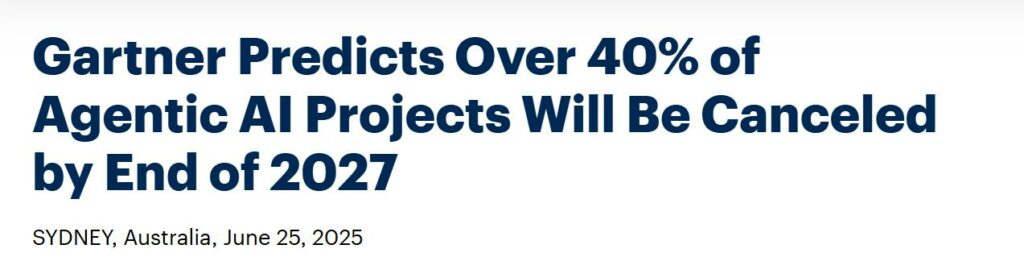
Gartner predicts that by end of 2027, over 40% of Agentic AI projects will be cancelled- undone by high costs, unclear ROI, and technical limitations.
The risk is sobering, especially at a moment when adoption is too high. Around seventy-nine percent of companies have already adopted AI agents, and the rest are planning to expand their usage across workflows.
This paradox-rising adoption paired with fragile success rates- underscores one truth: adoption alone is not enough. What determines whether projects succeed, or stall, is orchestration.
Handled well; orchestration ensures that agents scale reliably, integrate seamlessly, and remain cost-effective. Handled poorly; it leaves enterprises with fragmented experiments and runway expenses.
This article covers 7 AI Agent orchestrating best practices, the most common cost pitfalls, and the strategies to avoid them. But before diving into it, let’s take a step back for a quick refresher.
Quick refresher- What is AI Agent orchestration?
AI agent orchestration is the process of managing and coordinating multiple specialized AI agents within the unified system so they can work together towards the same goal. It sounds simple on paper, but in practice, it’s often where teams struggle the most.
Which naturally leads to the next question: What does it take to orchestrate AI agents effectively? To answer that, I turned to our AI experts, and they highlighted the following best practices to follow.
7 crucial AI agent orchestration best practices to keep in mind
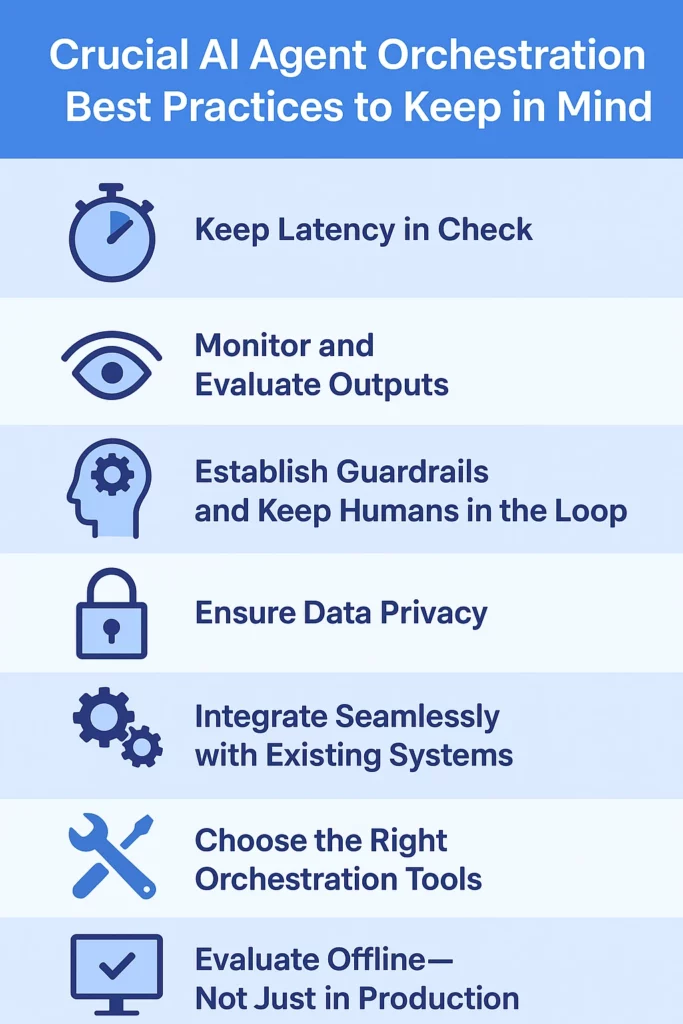
Keep Latency in check
Since agent workflows often rely on managed APIs, latency becomes a key factor. The response time varies depending on the type of agent built, the number of subtasks divided, and how many API calls are triggered.
Keeping latency in check ensures that the overall system doesn’t slow down under orchestration complexity.
Monitor and evaluate outputs
AI agents don’t always give reliable outputs. Whether you call it hallucinations or just “bad responses,” the point is this: you need a monitoring mechanism.
This includes log evaluation, providing context to the user, and scenario- based testing to ensure agents consistently generate outputs aligned with the intended use case.
However, bad responses are often symptom of a deeper issue: a lack of AI-ready data.
For a deeper look at this challenge, watch the session, “Is Your Data Ready for AI? Common Pitfalls and Practical Solutions”, by our Principal Architect, Ratnesh Parihar, who shares real-world strategies to make your data not just AI-friendly, but AI-future-proof.
Click to Watch Recorded Webinar
Establish guardrails and keep humans in the loop
Overreliance on GenAI without human oversite can create risks on two fronts: –
- Input side: Agents retrieving information they shouldn’t.
- Output side: Responses that are inappropriate or unsafe for end users.
Guardrails are needed both at the data access level and the output generation level. You can use role-based access restrictions, post-processing checks, and human-in-the-loop review, to prevent these issues. They keep orchestration safe, compliant, and trustworthy.
Ensure data privacy
While building any Agentic AI framework or Gen AI framework never funnel “everything” into an agent.
Data shared with agents should always be limited to what’s necessary for their role or task. This reduces exposer risks and keeps sensitive data off external APIs.
Integrate seamlessly with existing systems
Orchestration doesn’t exist in isolation. Whether you are building agents from scratch or embedding them into legacy environments, orchestration only works if it’s aligned with the larger tech ecosystem. Misalignment can create inefficiencies, duplication, or even failure points when combining legacy systems with new AI capabilities.
Avoid creating standalone components that don’t mesh with existing system; both should work cohesively for optimal performance.
Choose the right orchestration tools
The choice depends largely on the type of agents and the problem being solved. Ask yourself first are you building task-based agents (focused on executing workflows) or role-based agents (acting like specialists within a system)? The answer should drive your tool choice.
If your orchestration strategy relies heavily on human feedback and oversite, you will need a framework that can track scenarios and allows for checkpoints. Framework like LangGraph shine here as it prioritizes human-in-loop processes and state tracking, making them effective where oversight is critical.
Evaluate offline- not just in production
Beyond runtime monitoring, offline evaluation plays a vital role. This includes testing outputs across scenarios, validating guardrail effectiveness, and assessing cost implications before large-scale rollout.
You Might Also Be Interested In
Our experts recently explored the larger conversation around AI’s impact on software. You can watch this exclusive discussion “Will Agentic AI Replace or Reinvent SaaS?” with Alakh Sharma, Senior Data Scientist and Ritesh Agarwal, Solution Architect to get hands- on-insights from real product builds and understand the future of these converging technologies.
Watch Here: https://www.talentica.com/webinars/will-agentic-al-replace-or-reinvent-saas/
Cost considerations in AI orchestration
When asked about costs, our AI experts emphasized that expenses don’t arise from “implementing orchestration” itself but from API usage and scaling. For most startups, hosting their own LLM isn’t practical. Infrastructure demands and maintenance costs are too high, so they rely on third-party APIs.
This lowers upfront costs but shifts the burden to usage-based pricing, which can climb quickly as orchestration scales. While API calls may look inexpensive on paper, orchestration amplifies costs because agents rarely stop at a single request. Multiple calls per task, compounded across users, can quickly multiply token consumption and expenses.
Best practices to manage AI agent orchestration costs
Set limits on number of calls and tokens per agent
To prevent runway costs developers should set boundaries on both the number of APIs calls and token consumed. Without strict limits, projects may work well functionally but become financially unsustainable.
Select models strategically
Different models carry very different cost profiles. Let’s understand this better with real-world example that our AI expert shared.
While building a resume parser for one of our customers, the system had to process both images and text. Instead of sending everything to a vision model (expensive, with high token consumption), we routed text inputs to a lighter, cost-effective text model. Vision APIs were used only when necessary. This simple design choice reduced costs significantly without compromising accuracy.
Account for operational costs
Beyond raw API costs, orchestration also involves expenses tied to continuous monitoring, logging and feedback loops. These operational costs should be planned from the start to avoid surprises later.
The strategic payoff
Done right, ai agent orchestration opens up three strategic advantages for startups and enterprises:
- Operational efficiency– Reduce human effort in repetitive workflows.
- Resilience– Systems adapt automatically to context and change.
- Speed to innovation– Team can focus on higher –value tasks while Agent manages execution at scale.
It’s the difference between adding “AI features” and running an AI-native business.
Conclusion
AI agent orchestration holds immense promise, but also complexity. Success depends on building systems that are not only powerful, but also reliable, secure, and cost-efficient.
That’s where the right partnership makes all the difference. By combining proven practices with tailored strategies, you can move from POCs to production-ready systems that deliver real outcomes.
If you are exploring AI agent orchestration or already running into scaling and cost challenges – now is the time to put these 7 AI agent orchestration best practices into action.
Want to discuss how orchestration can fit into your AI roadmap? Let’s talk.