

Agentic AI is quickly becoming a boardroom priority. The Cloudera survey shows that 96% of enterprise IT leaders plan to increase their use of AI agents in the next 12 months. That’s basically everyone.

In this article, we’ll look at four options—AutoGen, CrewAI, LangGraph, and Swarm/OpenAI Agents SDK—and discuss where each one excels. That way, you’ll have a clearer picture of which framework fits best with your product goals.
Factors to consider when choosing Agentic AI development framework
Before you start comparing frameworks, zoom out for a second. The “best” framework isn’t the one trending on X or hyped in the latest VC memo. It’s the one that actually fits your business, your team, and your roadmap. Here’s how to think about it:
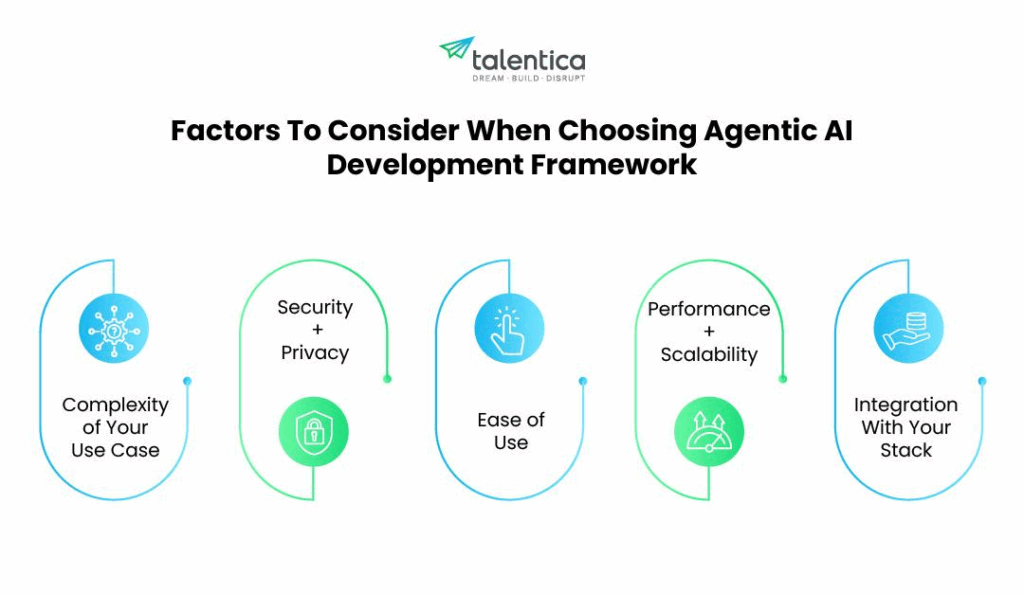
Complexity of your use case
What do you actually need agents to do? If it’s something light—like tagging support tickets—one simple agent will do the trick. But if you want an army of agents that can troubleshoot, suggest fixes, and hand things off when they hit a wall… you’re in multi-agent land. And that means you’ll need a heavier-duty framework.
Security + privacy
Agents will touch sensitive data. No way around it. So the framework has to have guardrails: encryption, access control, compliance checks. If you’re in a regulated industry, this can go from “nice-to-have” to “non-negotiable.”
Ease of use
Be honest about your team’s skills. Some frameworks give you plug-and-play templates and no-code options like n8n so you can spin things up fast. Others (like LangGraph) give you way more control but require actual coding chops. Pick the wrong one and you’ll end up stuck before you even get moving.
Performance + scalability
A slick demo means nothing if it crashes under real-world load. Test speed, stability, and responsiveness with your actual workflows. And don’t just think about today—think about what happens when usage 10x’s. Scalability is where good frameworks separate from the pack.
Integration with your stack
Agents can’t live on an island. They need to connect to your data, your infra, your tools. Decide where you’ll deploy (cloud, on-prem, hybrid) and test integrations early. It’s the difference between a smooth rollout and months of headaches.
You may also be interested in: To explore the challenges and best practices of adopting multi-agent systems—and how to fine-tune them for real-world impact. You can even check out our webinar
https://www.talentica.com/webinars/beyond-llms-the-power-and-pitfalls-of-multi-agent-ai/
Popular AI Agent frameworks
Once you’ve thought through your requirements, the next step is to look at the frameworks that are shaping how agentic AI is built today. Each one takes a different approach, and the right fit depends on what you want your agents to actually do.
LangGraph
If you’re in a business where workflows aren’t just linear—approvals, retries, human reviews— LangGraph stands out as a powerful orchestration engine. It doesn’t hide complexity behind a black box. It shows you how every decision flows.
It treats your agentic system like a graph, not just a script. Each node represents a task, tool call, or decision point. These connect into a stateful graph where information flows predictably and can loop, pause, or reroute as needed. That means you always know what’s happening and why.
Key strengths
- Stateful workflows with memory. Agents can pause, resume, and recall previous steps—even after interruptions.
- Human-in-the-loop support. You can drop in checkpoints for approvals or oversight wherever they’re needed.
- Streaming built in. LangGraph handles real-time flows (like token-by-token outputs) without slowing down performance.
- Open-source, free to use. Licensed under MIT, it’s cost-effective if you’re comfortable managing your own deployment.
Best fit scenarios
- Complex, multi-stage systems such as workflow automation, adaptive virtual assistants, or orchestration layers with retries and loops.
- Use cases where transparency is non-negotiable—like financial services, healthcare, or any regulated industry.
- Long-running tasks that must persist—for example, processes that recover smoothly even after a crash or system failure.
A quick example
Imagine a customer onboarding workflow. An agent collects documents, another validates them, and a third checks for compliance issues. If something looks off, the workflow pauses until a human approves it, then resumes without starting from scratch. LangGraph makes this orchestration straightforward and reliable.
How it compares
LangGraph offers the deepest level of control, but with that comes responsibility. It’s not as beginner-friendly as other frameworks, yet it’s the one that scales best as your requirements grow in complexity.
AutoGen
AutoGen, developed by Microsoft, is an open-source programming framework designed for building AI agents and facilitating cooperation among multiple agents to solve tasks. It provides an easy-to-use and flexible framework for accelerating development and research on agentic AI.
Instead of forcing agents into rigid request/response loops, AutoGen is built on an asynchronous, event-driven architecture. That means agents can talk to each other through messages, collaborate in flexible ways, and even run long-term, proactive tasks without falling apart. Think of it as infrastructure for complex, distributed agent networks that actually scale.
Key Strengths
- Asynchronous messaging. Agents don’t just wait for commands; they can collaborate through both event-driven and request/response patterns.
- Modular & extensible. You can plug in custom agents, tools, memory, and models—plus run proactive or long-lived agents.
- Observability built-in. Tracking, tracing, and debugging agent workflows isn’t an afterthought. With OpenTelemetry support, it’s enterprise-ready.
- Scalable & distributed. Designed for agent networks that need to work seamlessly across systems and org boundaries.
- Cross-language support. Python and .NET agents can work together—something most frameworks don’t handle well.
Where it fits best
- Complex, distributed systems where multiple agents need to coordinate.
- Research in multi-agent collaboration (because of its flexibility and extensibility).
- Applications where observability isn’t optional—finance, healthcare, compliance-heavy industries.
An Example
Imagine running a data analysis workflow where some agents are in Python and others in .NET. Normally, that’s a nightmare. With AutoGen, those agents can pass messages, collaborate, and you get visibility into every interaction. No black boxes, no guessing.
How it compares
The latest release (v0.4) doubled down on scalability, robustness, and cross-language collaboration. While other frameworks might optimize for single-agent orchestration, AutoGen is built for developers and researchers who want highly scalable, observable, multi-agent systems.
CrewAI
CrewAI is a Python-based framework designed to run AI “crews”—agents with specific roles, tasks, and tools—that work together like a well-managed team. Instead of one agent doing everything poorly, you get specialized agents collaborating to handle complex workflows faster and cleaner.
Most frameworks are extensions of LangChain or bolt-ons to existing stacks. CrewAI is built from scratch. That independence gives it speed, lean design, and more control. Its real differentiator? Role-playing orchestration. Agents take on defined roles, share knowledge, delegate, and solve problems together. Add “Flows,” and you get precise, event-driven control over execution—so your orchestration isn’t just smarter, it’s predictable.
Key strengths
- Role-based agent architecture. Assign agents specific roles and tools for clearer collaboration.
- Standalone framework. Built from scratch, independent of LangChain or any other agent framework.
- High performance. Optimized for speed and minimal resource usage, enabling faster execution.
- Flexible low-level customization. Full freedom to tweak everything—from system architecture and workflows down to internal prompts and agent behaviors.
- Ideal for every use case. Proven effective for both simple tasks and highly complex, enterprise-grade scenarios.
- Human-in-the-loop. Drop approval steps in workflows wherever oversight is critical.
Best fit scenarios.
- Automating multi-step, cross-functional business processes (market research, content ops, customer support).
- Running enterprise workflows that require precision, auditability, and scale.
- Collaborative problem-solving where specialized “agents” need to work like a coordinated team.
- Any use case where control and customization are non-negotiable.
A quick example
Take a marketing campaign- a Strategist agent defines objectives, a Content Creator agent produces ad copy and visuals, and a Social Media Manager agent schedules posts. CrewAI ensures they act as a coordinated team. With Flows, you can control the order of operations, introduce human approval where necessary, and guarantee that content is ready before social media posts go live.
How it compares.
CrewAI stands out for its structured, role-based approach. It’s easier to manage and scale than AutoGen’s free-flowing conversations, but less customizable than LangGraph. It’s particularly strong for enterprises that value reliability and predictable workflows.
Swarm/OpenAI Agents SDK
In 2024, OpenAI released Swarm, a lightweight framework that made it easier to prototype multi-agent workflows. Though sleek and useful for education, Swarm was never intended for production—it was more of a teaching tool, demonstrating how OpenAI envisioned agents as “LLMs with instructions and tool calls.”
Today, Swarm has evolved into the OpenAI Agents SDK—a production-ready framework actively supported by OpenAI. This evolution keeps the simplicity of Swarm but adds the reliability and scale needed for real-world deployments.
Why it works.
The OpenAI Agents SDK is built on two core principles: (1) give you just enough features to be useful, and (2) keep it simple to learn and customize. With primitives like Agents, Handoffs, Guardrails, and Sessions, you can express complex workflows while still staying close to native Python. Add built-in tracing, debugging, and evaluation, and you’ve got a toolkit that balances simplicity with production-level robustness.
Key strengths
- Agent loop. Automatically handles tool calls, responses, and iterations until completion.
- Python-first design. Orchestrate and chain agents using standard Python—no new abstractions to learn.
- Handoffs. Agents can delegate tasks to other agents, enabling multi-agent collaboration.
- Guardrails. Validate inputs/outputs in parallel to agents, breaking early if checks fail.
- Sessions. Automatically maintain conversation history across runs—no manual state handling.
- Function tools. Turn any Python function into a tool with schema generation + validation.
- Tracing built in. Visualize, debug, and monitor agent workflows; plug into OpenAI evals, fine-tuning, and distillation tools.
Best fit scenarios
- Teams that want to build agentic AI apps fast without a steep learning curve.
- Use cases where you need production-ready reliability but not an over-engineered framework.
- Developers who want Python-first orchestration with minimal abstractions.
- Workflows that benefit from built-in observability and tight OpenAI integration.
A quick example
Customer support: one agent handles FAQs, another escalates, guardrails validate responses, sessions track history automatically. Tracing lets you debug and improve flows as you go.
How it compares
Swarm was best for experimentation; the Agents SDK is geared for deployment. It’s not as feature-rich as LangGraph or as role-structured as CrewAI, but it’s perfect for those already in the OpenAI ecosystem who want a straightforward, supported solution.
How they compare at a glance
| Framework | Best for | Strengths | Trade-off |
| LangGraph | Complex, multi-stage workflows that need memory, retries, human review, and transparency. | Stateful graphs, human-in-the-loop support, real-time streaming, open-source & free. | Steeper learning curve; requires stronger coding skills and ops ownership. |
| AutoGen | Large-scale, distributed, multi-agent systems (esp. cross-language + research-heavy). | Asynchronous messaging, modular/extensible, enterprise observability, scalable, Python + .NET support. | More complex to implement; less beginner-friendly; heavier infra requirements. |
| CrewAI | Structured, role-based orchestration for business processes and enterprise workflows. | Role-playing agents, standalone design, fast + resource-efficient, flexible customization, human-in-the-loop. | Less transparent than LangGraph; less free-form collaboration than AutoGen. |
| OpenAI Agents SDK | Teams that want the fastest path from prototype to production inside OpenAI’s ecosystem. | Lightweight, Python-first, built-in guardrails, sessions, handoffs, tracing/debugging, tightly integrated with OpenAI. | Not as feature rich as LangGraph or CrewAI; less flexible for non-OpenAI environments. |
Bottom Line
- Choose LangGraph if you care most about control and transparency in complex systems.
- Choose AutoGen if you want multi-agent collaboration across systems and languages.
- Choose CrewAI if you need structured, role-based orchestration with both no-code and enterprise muscle.
- Choose OpenAI Agents SDK if you want the fastest path to production without the overhead.
The “best” framework isn’t universal—it’s about matching your deployment reality (cloud vs on-prem), your complexity level (lightweight vs enterprise), and your team’s capacity (quick wins vs long-term scalability).
Open source vs. commercial platforms: A strategic choice
Once you’ve narrowed down your framework, the next big decision is what powers it: do you build on open-source models or lean on managed, commercial platforms?
This isn’t just a technical call—it’s a business strategy.
For lighter workloads and low-traffic apps, commercial platforms often win. They handle infrastructure, scaling, and maintenance so your team doesn’t have to. But as usage grows, the economics flip. At scale, open-source models running on your own GPUs can be cheaper and give you tighter control over performance and costs.
It’s also not just about cost. Different models bring different strengths. Claude has proven strong in code-heavy tasks. GPT-4o shines when creativity and nuanced language matter. That means your choice should follow the job at hand—not a one-size-fits-all mindset.
The takeaway: model selection is strategic, not tactical. Pick based on your use case, your growth curve, and where you need flexibility most.
Beware the temptation of abstraction
Abstraction-heavy tools, like LangFuse and others, are a double-edged sword. They makes life easier in the beginning. You get faster prototypes, less overhead, and less time dealing with orchestration details. But here’s the catch: too much abstraction can turn your system into a black box.
When you’re deploying agentic AI in production, visibility matters. You need to know why an agent made a decision, how workflows executed, and where things broke. Without that, debugging becomes guesswork and compliance risks go up.
Convenience is great for demos. But in real-world deployments, transparency and control are non-negotiable.
Conclusion
At the end of the day, there’s no “best” AI agent framework—there’s only the one that’s best for you. Some teams want full control, others just want speed. Some need enterprise-grade orchestration, others just need something lightweight to test ideas.
The key is simple: don’t get stuck in analysis paralysis. Pick a framework, run a small experiment, and see how it fits your stack. The faster you learn what works (and what doesn’t), the faster you’ll get real business impact from agentic AI.
If you’re a founder, CTO, or product leader looking to move from exploration to execution, partnering with an experienced Agentic AI development company can make the difference between experimentation and real business impact.
👉 Let’s talk about how we can help you pick the right framework, tailor it to your needs, and get to market faster.