

Every enterprise today wants to move fast with AI.
Proof-of-concepts are being greenlit overnight. Teams are racing to embed models, spin up agents, and layer in LLM-powered workflows.
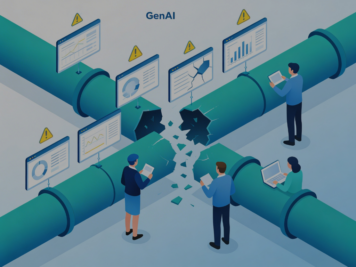
But speed is not a problem. The problem is the ground they are standing on.
A new research found that 81% of U.S. companies working with AI are still struggling with data quality, putting ROI and project timelines at serious risk. Even Gartner predicts that by 2026, 60% of AI initiative without AI- ready data will be abandoned.
And that’s the real story behind AI readiness today. Most U.S. enterprises are moving forward without fully understanding whether their data is ready to support these intelligent systems.
To dig deeper into this, we recently hosted a webinar on Data Readiness for AI, featuring our Principal Architect, Ratnesh Parihar. The session concluded with a powerful Q&A segment, where he addressed questions; enterprises are asking as they prepare their data systems for AI adoption.
Below, we share those key questions and his in-depth perspectives to help you assess whether your data is truly ready to power AI.
What’s the number one red flag that indicates your enterprise, or your data may not be ready for AI?
Ratnesh put it bluntly “Poor data quality is the number one red flag.”
When enterprises begin their AI journey, they often assume their existing data warehouse or lake will do the job. But according to Ratnesh, that’s where things usually start to go wrong.
“When we ask teams to define a golden standard of data — what good looks like — that’s where everything falls apart.”
The problem isn’t just uncleaned or incomplete data. It’s the absence of shared definitions, implicit quality checks, and consistent validation mechanisms.
Once you expose your data warehouse to AI, you lose predictability. Models start accessing unknown or unverified data, triggering false positives and hallucinations. And unlike traditional systems, you can’t just hard-code your way out of that chaos.
That’s why data quality has to be engineered — not assumed.
AI readiness starts with establishing a golden standard, setting automated quality checks, and creating continuous validation loops before the first model ever trains.
If someone wanted to get started with AI, what should be the first step?
It depends on whether or not you already have data warehouse/lakes/pipelines in place.
Case 1 – If you do have
It’s tempting for stakeholders to assume:
“We already have a data warehouse. Let’s just build a RAG pipeline on top of it.”
That, according to Ratnesh, is a fundamental misunderstanding.
“You can’t go to your stakeholder and say, ‘Yes, we have a data warehouse, so we can build RAG on top of it.’ That’s not the way to go.”
A data warehouse is built for structured, transactional data.
AI — especially Generative AI — needs context, embeddings, chunking logic, and efficient storage for semantic retrieval.
So, if you already have a data strategy in place, AI readiness isn’t about tearing it down — it’s about redesigning it for new data behaviors:
- Understand how data will be chunked and embedded.
- Plan how embeddings will be stored and secured.
- Balance new tools and pipelines against cost efficiency.
Case 2 – If you don’t yet have
Ironically, life’s a little easier. You can design it right from scratch—aligned with your AI vision rather than bolted onto legacy systems.
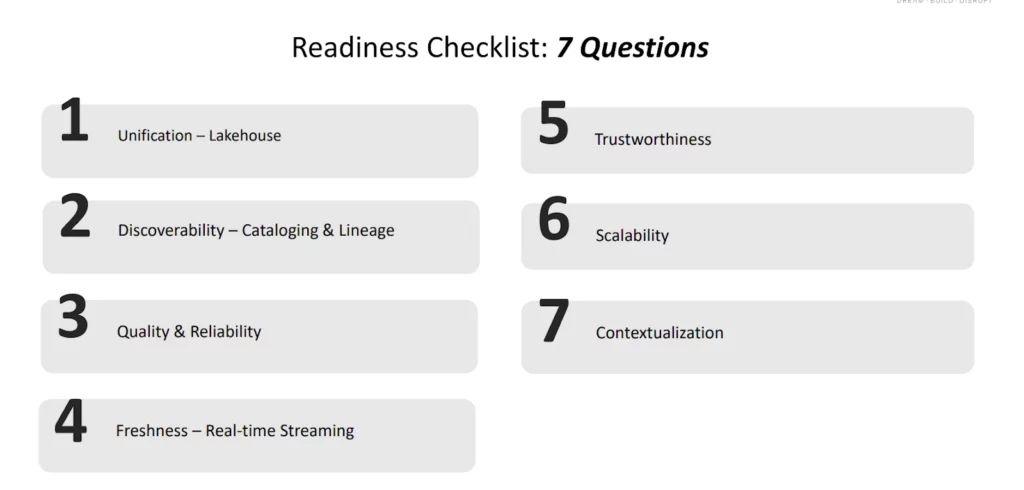
“Define your use cases first, once that is defined, then look for data. What kind of data will be required and then you can go through the 7-point data readiness checklist that I have discussed in the webinar.”
Enterprises that get AI right usually pass through these seven checkpoints before scaling workloads.
Looking to go in deep? Catch the on-demand recording here: https://www.talentica.com/webinars/is-your-data-ready-for-ai-common-pitfalls-and-practical-solutions/
What factors drive the choice of specific tools for data readiness?
When it comes to building data lakes and pipelines, enterprises often face a fork in the road: Should they go open-source or enterprise-grade?
“You can build your whole data lake in Kubernetes, or you can build it on Databricks,” Ratnesh explains. “Databricks might seem costlier, but it gives you a lot of convenience — smoother pipelines, easier deployment, and strong AI integration. Moreover, they have invested heavily in the AI side in the last 2-3 years”.
The takeaway:
AI readiness isn’t about chasing the cheapest or trendiest stack. It’s about benchmarking for scalability and maintainability.
Enterprises can start with managed solutions like Databricks for speed and reliability, then gradually move toward open-source Kubernetes-based setups once governance and cost structures mature.
How to strike a balance between rapid experimentation and data governance, especially in this fast-moving Gen-AI environment?
AI teams are under pressure to experiment fast — to prove value early and often.
But unchecked experimentation leads to governance chaos, while too much governance slows everything down.
Ratnesh explains how to strike the right balance:
“You can’t wait for data governance to finish before you start building your POCs. But you also can’t skip it. The answer lies in using the right tools.”
He highlights DBT (Data Build Tool) as a critical enabler.
It lets teams do fast prototyping, quick schema evaluation, and the team can build the whole data governance utility catalog over there.
Similarly, tools like Databricks Delta Live Tables (DLT) help maintain always-updated data pipelines.
Unlike static tables, these update automatically as new events flow in — so data freshness is baked into every experiment.
Together, tools like DBT and DTS help enterprises prototype fast, but responsibly.
You get speed and trust — not one at the expense of the other.
How different industries are approaching AI readiness, and are there any differences or surprising patterns of similarity?
Data readiness challenges aren’t uniform.
Different industries approach AI differently — and face unique bottlenecks.
In SaaS
SaaS companies are racing ahead to embed AI agents directly into their platforms. They are viewing agentic systems as the next major disruption.
These companies are rethinking their entire architecture to support a plug-in model, where agents can “pop-up,” interact with existing MCP servers and autonomously perform tasks.
Many are also exploring ways to monetize these agents through licensing models layered on top of their existing infrastructure.
This is driving a major architectural rethink:
SaaS products are evolving from static software to dynamic, AI-augmented ecosystems — requiring modular plug-in structures and clear data interfaces between agents and systems.
The challenge isn’t just engineering those agents — it’s structuring data for safe, controlled agent interaction.
In FinTech
FinTechs, by contrast, are advancing with measured caution.
They understand AI’s potential — from hyper-personalized recommendations to smarter fraud detection — yet their progress is tempered by regulation. With PCI and GDPR compliance always top of mind, every data movement must withstand scrutiny.
As Ratnesh explains, “FinTechs are hesitant to use AI, not because they doubt its value, but because they operate under heavy regulatory oversight. For them, every new data process is a potential compliance risk.”
The challenge runs deeper when it comes to embeddings. Creating embeddings or semantic indexes — critical for search and recommendation systems — inherently involves generating new data representations. In regulated environments, that can be interpreted as data replication, which may violate PCI guidelines.
This creates a paradox: without embeddings, AI systems lose the ability to perform semantic search and contextual reasoning; with embeddings, FinTechs risk non-compliance.
To navigate this, the sector is moving toward security-conscious AI design, emphasizing:
- Isolated data environments that limit exposure and control data lineage.
- Embedding strategies that preserve utility without replicating sensitive data.
- Auditable workflows that demonstrate to regulators how AI systems uphold compliance.
Despite the constraints, momentum is building. FinTechs are beginning to see tangible value in fraud prevention, credit scoring, and personalized recommendations — and that’s fueling a more pragmatic approach to AI adoption. They’re not moving fast, but they’re moving deliberately, ensuring that innovation and compliance progress together.
AI readiness isn’t about technology — it’s about trust
Enterprises that rush into AI without addressing data readiness end up struggling with unreliable outcomes, mistrust among teams, and escalating costs from rework.
The irony?
They think they’re accelerating, but they’re actually delaying real impact by skipping foundational work.
Ratnesh summarizes it perfectly:
“You can add all the tools you want — but if your data isn’t ready, AI will amplify your problems, not solve them.”
AI readiness, then, isn’t about how quickly you deploy, but how confidently your data can support what you deploy.
It’s about designing systems that know what “good” data looks like — and can sustain that quality as your AI matures from experimental to operational.
Conclusion
Most enterprises today are in the same place: they’ve proven AI’s potential in pilots but can’t scale it reliably.
The missing link isn’t talent or tools — it’s data readiness.
As AI evolves from predictive to generative to agentic, the cost of poor data readiness multiplies.
Quality, governance, and trust can’t be retrofitted later. They must be engineered in from day one.
Because in the end, your AI is only as smart as your data is ready.
If you are looking to bridge this data readiness gap, we can help you – from designing AI-ready data architectures to implementing secure, compliant pipelines that scale with business goals.
Our team of AI–native engineers bring deep experience in data engineering, MLOps, and Gen AI integration, helping organizations move from proof-of-concept to production with confidence.
If your enterprise is exploring AI adoption or struggling to align data infrastructure with AI goals, it’s worth starting with a conversation.
Talk to our AI experts and see how we can help you make your data ready for AI.
Author’s Note:
This article is based on insights from our Principal Architect, Ratnesh Parihar during a webinar on AI Readiness: Is Your Data Ready for AI? With supporting context from Qlik’s 2025 Data Literacy and AI Readiness Report.