

Product discovery is the most fragile and assumption-heavy stage of building a product. In 2024, Microsoft wasn’t ready for the huge outcry Windows Recall generated. The feature was supposed to capture screen activity. They shelved the project in June once they realized the team had not addressed its security and privacy concerns. Product failure means the loss of weeks’ bandwidth of the entire team, spent in workshops, synthesizing research, drafting personas, mapping journeys, and debating hypotheses. It reveals a misalignment between what users actually want and what was built.
According to CB Insights, 35% of startups fail because there is no market need for their product. For a startup, wasting months only to realize they are on the wrong track could be catastrophic. The statistic shows that the biggest risk isn’t execution but validation.
Traditional discovery cycles take 6–12 weeks. Market conditions, sometimes, shift by the time research is complete and prototypes are tested. AI is changing this process- not by eliminating discovery but by compressing it.
What Is Product Discovery and Why Is It Slow
Product discovery is the process of validating whether a problem is worth solving and whether the proposed solution will deliver value. It has several steps- problem framing, market research, persona building, journey mapping, hypothesis definition, early prototyping, and user validation.
Complexity is a major factor that makes the process slow. But it is not the only one. Manual synthesis also consumes time. Steps like designers clustering workshop notes or product managers reading through dozens of interview transcripts are labor-intensive. Competitive analysis also includes hours of browsing product documentation and reviews.
Let’s take a B2B SaaS startup building workflow automation software as an example. The team might interview 15 operations managers to understand customer pain points where each interview produces pages of notes. Then, someone has to take the onus of clustering recurring themes like “approval delays,” “lack of visibility,” and “manual reconciliation.” This clustering could be slow-moving.
AI reduces the mechanical weight of this process.
How AI Is Transforming Product Discovery
AI for Market & Competitor Intelligence
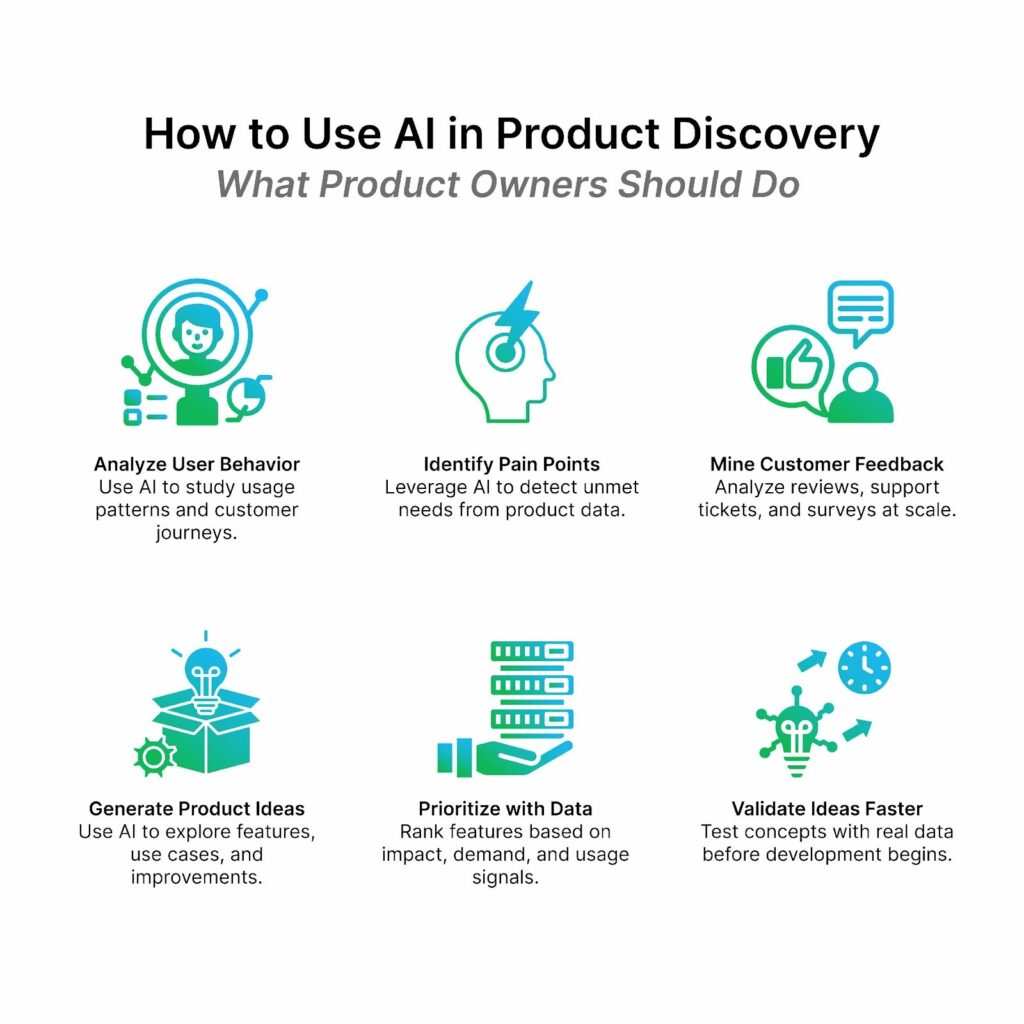
Competitor analysis involves studying structured spreadsheets and hours of browsing feature pages and G2 reviews. AI tools can scan product reviews, feature descriptions, and user sentiment within minutes.
For example, a platform like G2 hosts thousands of product reviews across industries. AI tools can fast-track the identification of repeated complaints or unmet needs and summarize recurring dissatisfaction patterns such as “slow reporting dashboard” or “complex onboarding”.
A niche B2B domain like compliance in fintech could be a corner case worth noting where AI might hallucinate competitors or misinterpret overlapping categories. This makes human validation essential.
AI-Powered Problem Framing
Problem framing is never linear. Stakeholders say different things. Sales teams always prioritize revenue drivers. Engineering teams demand feasibility. Designers look for on usability.
AI can ingest workshop transcripts and cluster themes automatically. Developers can use ChatGPT or Claude to identify contradictions in assumptions and draft structured problem statements in minutes which are easier to understand than manually sorting sticky notes.
AI in Persona & Journey Mapping
Creating personas requires qualitative synthesis. AI can draft initial personas based on interview transcripts or demographic inputs. For example, if you put feedback from early adopters of a health-tracking app, AI can generate segments like “data-driven fitness enthusiast” or “casual wellness tracker.” Along with these, the tool can also propose journey maps showing onboarding friction or drop-off points.
But AI personas often feel statistically accurate but emotionally shallow. Subtle motivations can only be unearthed from live interviews. In early-stage startups where user data is limited, AI personas should not be treated as the truth.
AI for Rapid Concept & Prototype Testing
The most dramatic shift is in prototyping. Previously, designers created wireframes manually before moving to high-fidelity mockups. Today, AI tools can generate UI concepts from prompts in minutes.
Many startups partner with engineering teams specializing in AI development services to rapidly build and validate AI-powered product experiences.
However, speed sometimes compromises depth. AI-generated prototypes often look polished which creates an illusion of depth. If not reviewed properly, teams may opt for a direction because the design “looks complete.” Also, AI tends to play safe which can dilute uniqueness. This may be a bottleneck for startups as they prefer differentiation.
From Idea to Validation: The Compressed AI-Enabled Cycle
The AI-native lifecycle functions as a closed loop where every output is validated immediately. It begins by transforming raw business intent into a structured set of machine-readable specifications, constraints, and examples. This creates a high-fidelity context for development. AI agents then rapidly generate functional artifacts, ranging from code to design prototypes, while operating within predefined safety and style guardrails.
This generated output is pushed into a rigorous validation phase. The phase includes automated testing, security scanning, and architectural reviews to provide instantaneous feedback on quality and viability. The cycle closes when results are turned into actionable learning. Bug reports and production telemetry then refine the next set of priorities and continuously sharpen the product’s direction.
AI shortens the development cycle by removing human-bandwidth constraints and enabling parallel workflows. This creates an opportunity to validate multiple design directions simultaneously. Rapid prototyping allows for the creation of interactive demos and user feedback sessions within hours. Automated synthesis increases this speed further, where AI transcribes user interactions and flags recurring pain points for product managers. This entire process leads to cognitive compression and removes data latency in complex fields by integrating fragmented information into actionable insights.
Where AI Fails in Product Discovery
Bias is a huge issue. The UK’s passport application photo checker is a great example of how AI’s inherent limitations can affect product outcomes. The model rejected 22% of dark-skinned women compared to 14% of light-skinned women. A human-in-the-loop approach could have solved this racial bias. If AI is trained on mainstream digital product data, it may lean toward consumer-friendly UX patterns without considering the complexities of an enterprise tool.
Confidence without context is another drawback. Large language models generate plausible insights even when there is zero or minimal data as a foundation. A classic corner case is hallucinated competitors. AI may give you a detailed list of “emerging competitors” that don’t belong to the same domain.
Gartner’s prediction for AI-related failures is quite high. According to their report, 30% of the products will fizzle out due to lack of AI governance, poor data quality, inadequate risk controls, escalating costs and unclear business value.
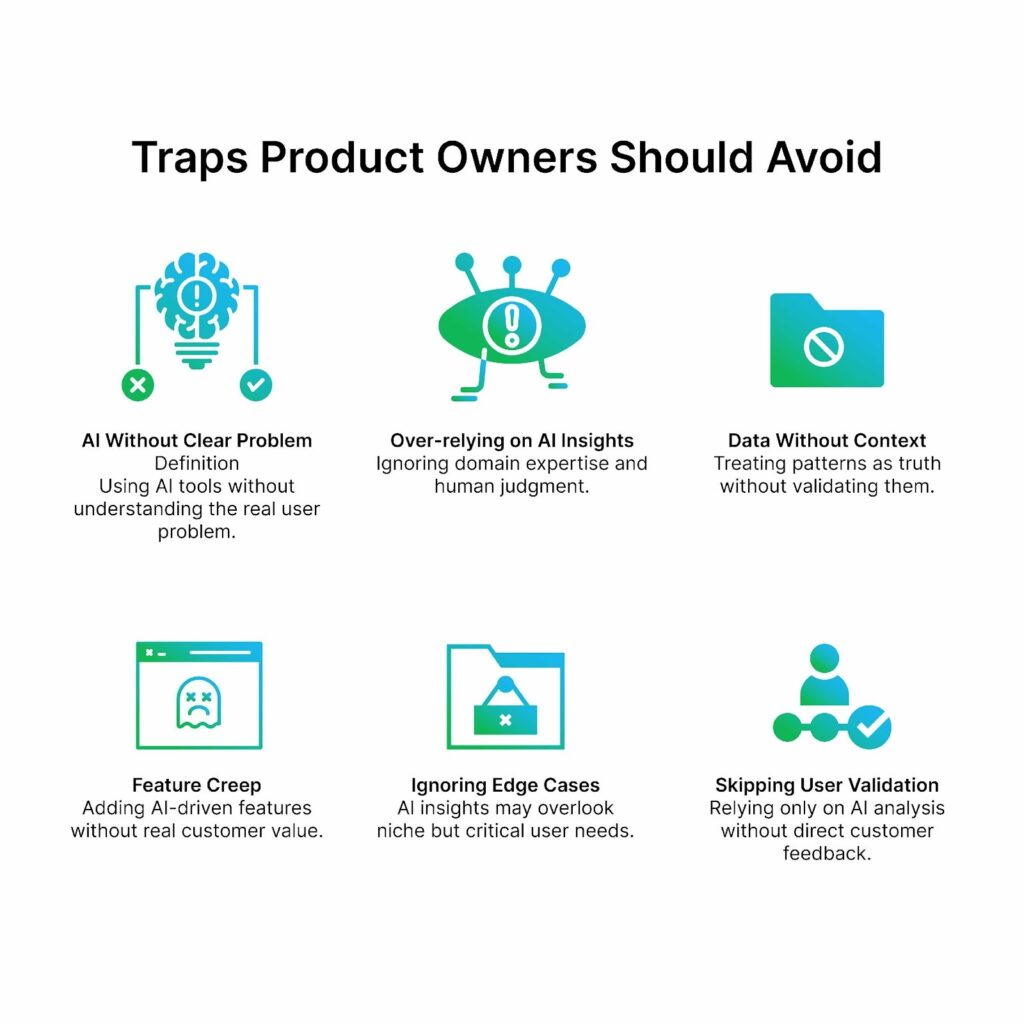
The Human-in-the-Loop Discovery Model
The most effective model is hybrid. All those loud claims of AI replacing humans are not totally correct. AI still cannot function without human intervention. What you can do is deploy the best of both. Let AI accelerate exploration and let humans validate and refine.
AI can be used to cluster feedback and generate initial flows. Once that is done, the team can then conduct 2–3 real interviews to validate assumptions. This leads to five prototype directions, after which the team can manually interrogate edge cases. The entire process treats AI outputs as hypotheses — not decisions.
Let’s consider a fintech startup as an example. It can design a conversational interface to draft multiple tone variations for chatbot interactions. Human designers would then refine the tone as per regulatory compliance guidelines and brand voice.
Conclusion
AI in product discovery is not about replacing thinking. AI should free up cognitive bandwidth by doing mechanical tasks like reducing synthesis time, accelerating prototyping, and increasing validation cycles.
Humans should oversee framing the right problem, validating with real users, and differentiating strategically.